
Telescopic Roller Conveyor
Telescopic Roller Conveyor
A telescopic roller line bridges your dock to the trailer floor, carries cartons and bags deep into the vehicle, then retracts so the bay stays usable when nothing is loading.
- Dock-level loading
- Widths 50 / 60 / 80 cm
- Custom 1 m and wider
- Retracts compactly
Overview
For sites with a loading dock where the trailer floor sits level with the platform, and for flat in-plant transport.
At a loading dock the expensive part of loading is walking. A telescopic roller conveyor removes the walking: operators place cargo at the building end and the line carries it to the person stacking inside the trailer, then the whole boom retracts back in.
Because it is built for platform-height work, this line is also used for straight, powered transport inside a warehouse, moving goods between two points on one floor without a forklift trip.
Specifications at a glance
| Parameter | Specification |
|---|---|
| Application | For sites with a loading dock where the trailer floor sits level with the platform, and for flat in-plant transport. |
| Width options | Standard widths 50 / 60 / 80 cm; custom 1 m, 1.2 m or wider. |
| Roller surface | Rubber-coated rollers for bagged cargo (woven, sack, kraft bags); bare rollers for flat-bottom cartons, foam boxes and totes. |
| Build & sections | Each unit is a non-standard custom build to your site dimensions; long lines are built in sections and retract compactly when not in use. |
Every unit is configured to your dock height, vehicle mix and required reach. The table above is the standard range, not a fixed bill of materials.
How it works on the dock
- The trailer backs onto the dockThe line sits at platform height so its deck meets the trailer floor without a ramp.
- The boom extendsSections telescope out until the discharge end is where your stacking crew is working.
- Cargo flows down the lineOperators load at the building end; the roller surface is matched to your cargo so nothing stalls mid-line.
- The boom retractsWhen the truck leaves, the line collapses back to a compact parked length and the bay is clear again.
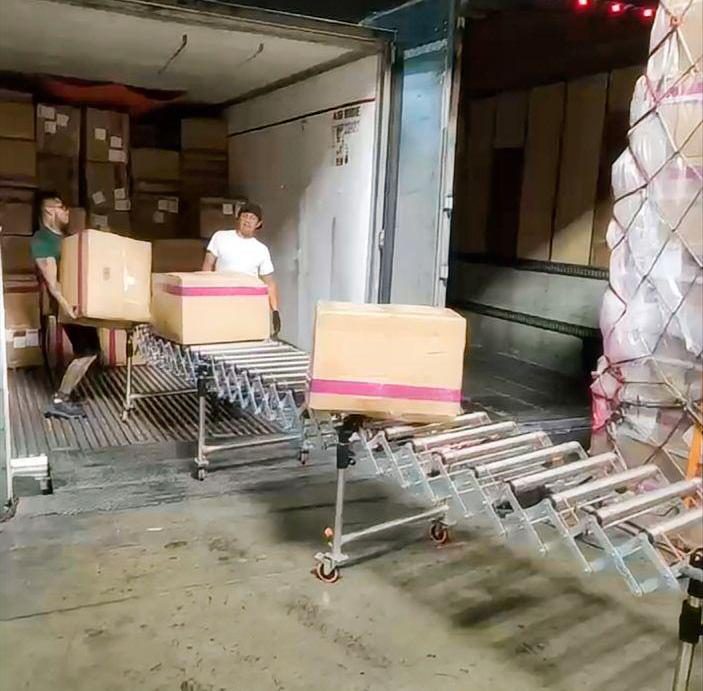
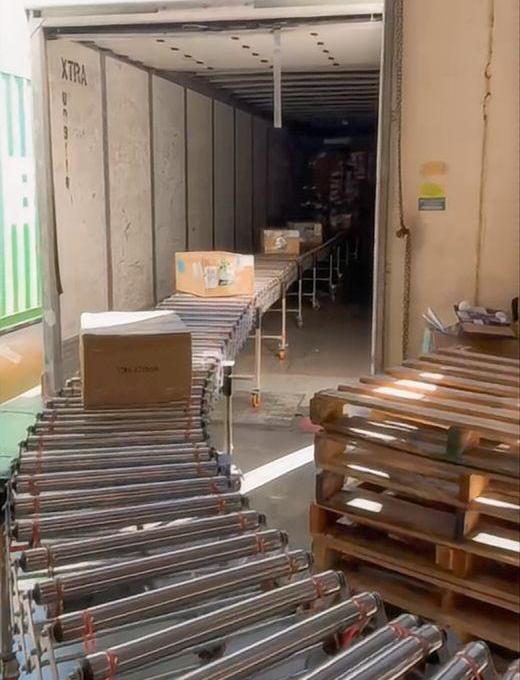
Roller lines in the workshop
Clips from our workshop floor: roller lines with an incline section, and a close look at the roller surface and telescopic joint.
Where it is used
Dock-served distribution
Outbound bays where the trailer floor already meets your platform and throughput does not justify a boom truck.
Container stuffing
Stripping or stuffing 20 and 40 ft containers where cargo has to be placed far inside the box.
Bagged and baled goods
Rubber-coated rollers keep woven, sack and kraft bags moving instead of slipping on bare steel.
In-plant transport
Straight powered runs across a floor: receiving to storage, packing line to staging.
Manufacturing despatch
Finished goods leaving on curtain-siders and box trucks of mixed lengths.
Third-party logistics
Shared bays handling several vehicle types a day, where setup time matters more than peak speed.
Configuration & drawings
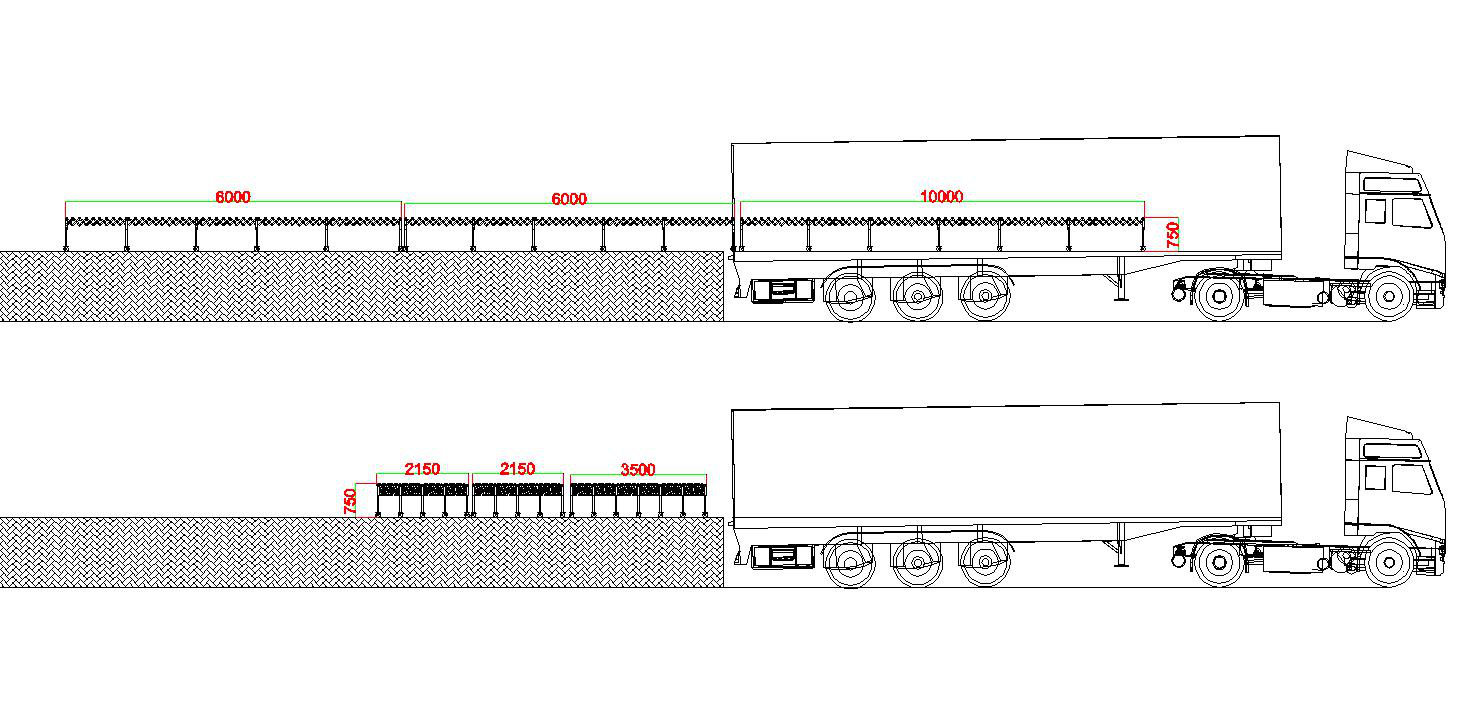
Drawings are produced for your site before anything goes into build, so you can check the parked length against your bay and the extended length against your longest vehicle.
- Width: 50, 60 or 80 cm standard; 1 m, 1.2 m or wider on request
- Roller surface: rubber-coated for bagged cargo, bare for cartons, foam boxes and totes
- Extended length set by how far into the vehicle you must place cargo
- Retracted length checked against the space available at your bay
- Section count defined by shipping and installation access
What we need from you
These six inputs are usually enough to propose a configuration. Site photos speed it up more than anything else.
- Dock height above yard floor, and whether it varies between bays
- Longest and shortest vehicle bodies you receive
- Container work: 20 ft, 40 ft, and whether you load them on the ground or at the dock
- Cargo type per load: bagged, cartons, foam boxes or totes
- Piece dimensions and weight, including the heaviest you expect
- Bay width and available ceiling / door height
Roller conveyor FAQ
What widths can I order?
Standard widths 50 / 60 / 80 cm; custom 1 m, 1.2 m or wider.
How do I choose the roller surface?
Rubber-coated rollers for bagged cargo (woven, sack, kraft bags); bare rollers for flat-bottom cartons, foam boxes and totes.
Can it be built outside the standard sizes?
Each unit is a non-standard custom build to your site dimensions; long lines are built in sections and retract compactly when not in use.
Is this the right line if I have no loading dock?
No. This line is built for dock height. Ground-level loading needs the hydraulic lift & incline conveyor.
Can I use it for containers?
Yes. Container work is a standard application; tell us whether the container sits on the ground or at the dock.
Tell Us About Your Loading Needs
Dock height, vehicle mix and cargo. Our team will recommend a suitable configuration and follow up with product information.
Get a Free Quote