
Telescopic Belt Conveyor
Telescopic Belt Conveyor
A continuous belt surface instead of rollers, so irregular parcels (soft mailers, small boxes, mixed sizes) travel without jamming between rolls. Three standard extension lengths (6 m / 8 m / 12 m) are confirmed; built for volume, and available for dock and ground-level sites alike.
- Widths 60 / 80 cm
- Custom 1 m
- Extends 6 m to 12 m
- One operator per end
Overview
Roller lines assume cargo with a reasonably flat underside. Parcel networks rarely have that luxury. A belt surface carries almost anything you put on it, which is why this is the line specified for express hubs, e-commerce fulfilment and returns handling.
It is also the only one of the three that can be set up both ways: fixed at a dock, or with a mobile base that lets you load from the ground.
Specifications at a glance
| Parameter | Specification |
|---|---|
| Application | Built for express and logistics parks and cargo with mixed package types and sizes; works with or without a loading dock. |
| Widths & extension | Standard widths 60 / 80 cm; custom 1 m. Extends 6 m to 12 m. |
| Extension models | Telescopic belt conveyors are described by extension length: 2-section model extends 6 m (folded 7 m); 3-section model extends 8 m (folded 6 m); 4-section model extends 12 m (folded 6 m). When fully extended the 12 m model is about 18 m overall. |
| Setup & staffing | No-dock setup: mobile high stand + hydraulic lift arm + front operator platform + tail incline line; one operator per end. |
| Speed & control | Conveyor speed is adjustable via a frequency inverter, up to 40 m/min; bidirectional conveying is available. |
| Load capacity | Load capacity is 80 kg per metre of conveyor for standard belt and roller lines. Single items are best kept within 80–100 kg; items of 100–150 kg can be handled with a reinforced custom build, and any single item above 120 kg requires separate engineering review. Bagged cargo must be conveyed on rubber-coated rollers or a belt surface; on roller lines the minimum item length is about 10 cm so pieces do not fall between rollers. |
| Power supply | Standard factory supply is single-phase 220 V; three-phase 380 V and 50 Hz or 60 Hz are available on request. The inverter tolerates ±20% voltage variation; overseas supplies such as 110 V (US) require an external transformer, quoted separately. |
Model specifications
The belt line is built in three extension lengths, confirmed with the factory: Telescopic belt conveyors are described by extension length: 2-section model extends 6 m (folded 7 m); 3-section model extends 8 m (folded 6 m); 4-section model extends 12 m (folded 6 m). When fully extended the 12 m model is about 18 m overall. Widths follow Standard widths 60 / 80 cm; custom 1 m. Extends 6 m to 12 m., and each unit is then configured around your vehicle, cargo and site.
| Parameter | 2-section · extends 6 m | 3-section · extends 8 m | 4-section · extends 12 m |
|---|---|---|---|
| Extension length | 6 m | 8 m | 12 m |
| Folded length (reference) | 7 m | 6 m | 6 m |
| Load capacity | 80 kg/m | 80 kg/m | 80 kg/m |
| Conveying speed | 10-40 m/min (VFD) | 10-40 m/min (VFD) | 10-40 m/min (VFD) |
| Bidirectional conveying | Standard | Standard | Standard |
| Power supply | Single-phase 220 V standard | Single-phase 220 V standard | Single-phase 220 V standard |
| Belt width | 60 / 80 cm; 100 cm custom | 60 / 80 cm; 100 cm custom | 60 / 80 cm; 100 cm custom |
| Applicable cargo (guidance) | Mixed parcels, poly mailers | Cartons, parcels, small boxes | Heavy cartons, totes, mixed loads |
| Setup | Dock or no-dock | Dock or no-dock | Dock or no-dock |
| Optional equipment | Mobile base, hydraulic lift, operator platform, remote control | Mobile base, hydraulic lift, operator platform, remote control | Mobile base, hydraulic lift, operator platform, remote control |
The factory does not use formal model codes for this line, so models are named by extension length; there is no 10 m extension, and the next step up from 8 m is 12 m. Folded lengths are reference figures; final dimensions are confirmed in the configuration drawing for your site. Load capacity and power supply are common to all three builds. Applicable cargo is guidance for shortlisting, not a specification.
Dock and no-dock setups
Dock setup
Fixed at the platform
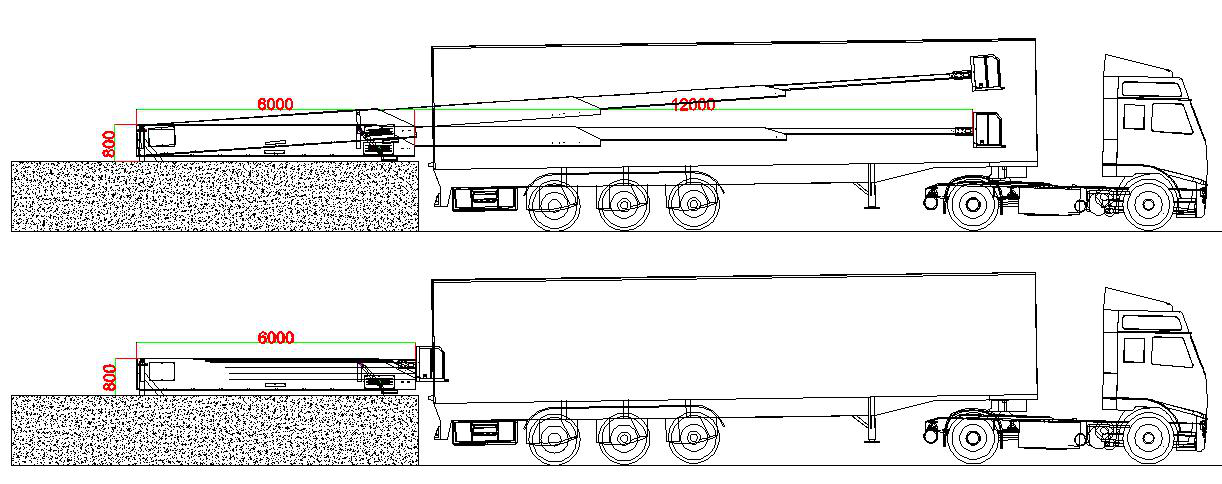
The boom telescopes into the trailer from dock height. Parcels are fed from the building side (usually straight off your existing sort line) and placed by the operator at the far end.
- Integrates with upstream sorting conveyors
- No height adjustment needed between trucks of similar bed height
No-dock setup
Mobile base & lift arm
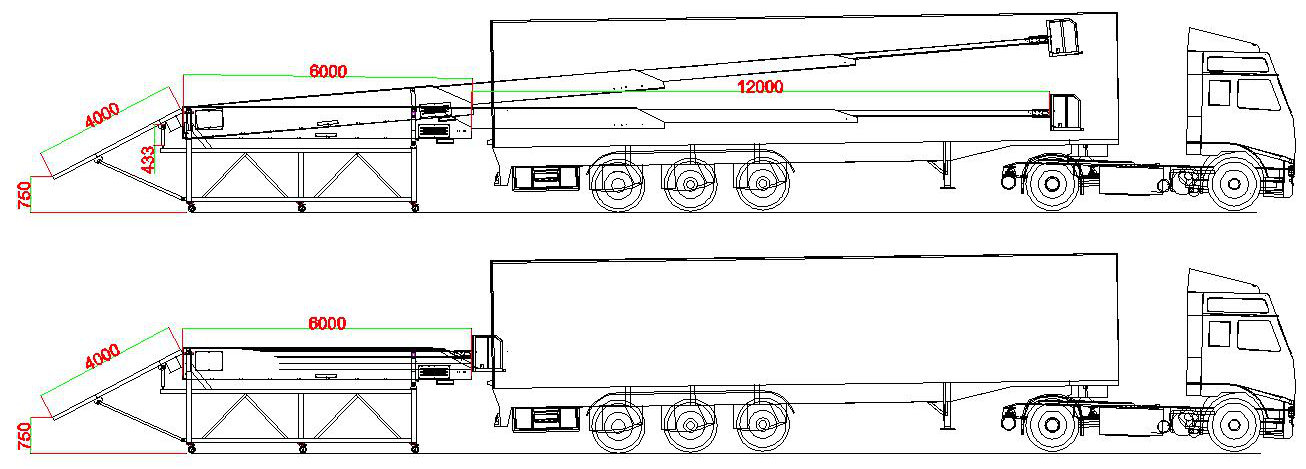
Mobile high stand + hydraulic lift arm + front operator platform + tail incline line; one operator per end.
- Brings the line to whichever door is busy
- Staffing predictable: one operator per end
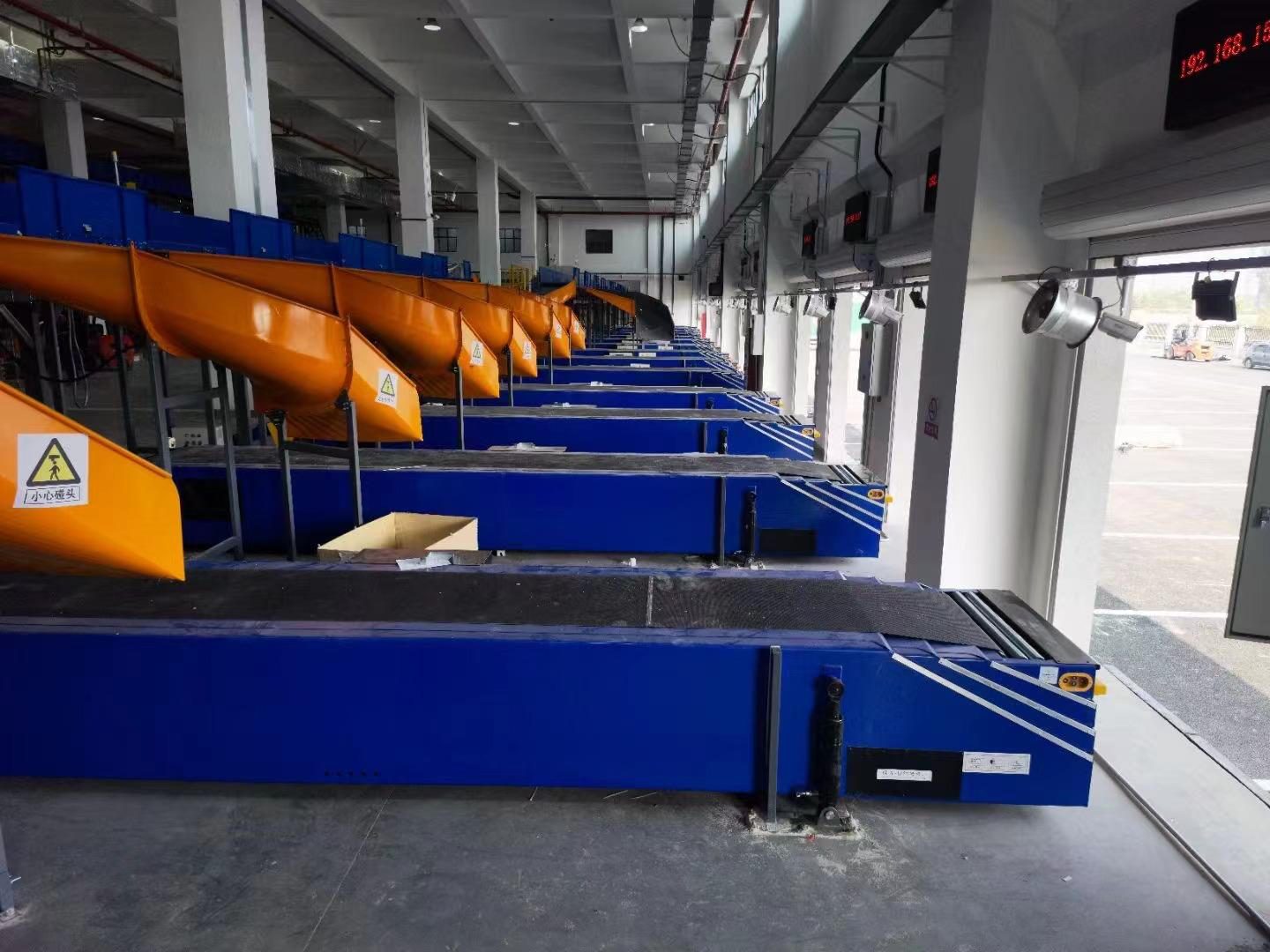
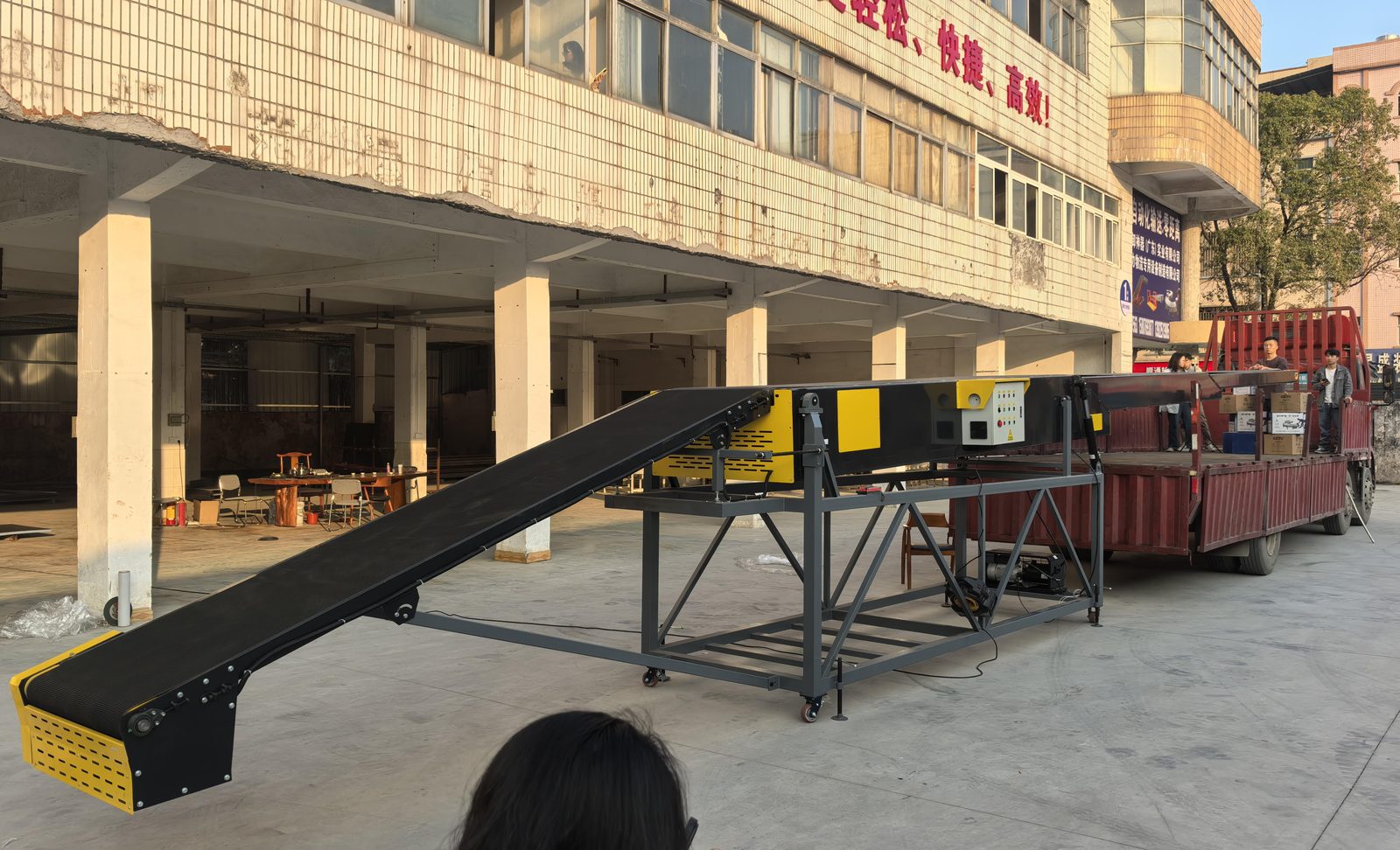
Telescopic belt conveyor on the floor
A close look at the belt surface, the frame and the side control box of a telescopic belt conveyor.
Where it is used
Express & parcel hubs
Mixed sizes and shapes at high volume, where jamming between rollers costs minutes every hour.
Logistics parks
Shared buildings handling several tenants with completely different package profiles.
E-commerce fulfilment
Poly mailers, small cartons and irregular shapes moving out in dispatch waves.
Returns handling
Unpredictable shapes and packaging condition arriving back through the same door.
No-dock parcel sites
Mobile setup with hydraulic lift arm where the building has no platform at all.
Peak scaling
Extra line capacity added for seasonal peaks without rebuilding the dock.
Configuration drawings
Reference setups (the dock installation and the mobile no-dock arrangement) are drawn with dimensions; for standard equipment the drawing can come at the quotation stage, and for non-standard builds after order confirmation, with your approval before production.
What we need from you
- Whether you load from a dock, from the ground, or both
- Peak parcels per hour you need to sustain
- Smallest and largest piece dimensions on your line
- Longest vehicle body you load, and its bed height
- Whether the line must connect to existing sorting equipment
- Available belt width preference: 60, 80 cm or wider
Belt conveyor FAQ
What widths does it come in?
Standard widths 60 / 80 cm; custom 1 m. Extends 6 m to 12 m.
How far does it extend?
It extends 6 m to 12 m; the exact stroke is set by how deep into the vehicle you need to place parcels.
Do I need a loading dock?
No. It can be installed at a dock or set up on a mobile base for ground-level loading.
How many people does it take to run?
No-dock setup: mobile high stand + hydraulic lift arm + front operator platform + tail incline line; one operator per end.
What kind of cargo suits a belt rather than rollers?
Built for express and logistics parks and cargo with mixed package types and sizes; works with or without a loading dock.
How much load can the belt carry?
Load capacity is 80 kg per metre of conveyor for standard belt and roller lines. Single items are best kept within 80–100 kg; items of 100–150 kg can be handled with a reinforced custom build, and any single item above 120 kg requires separate engineering review. Bagged cargo must be conveyed on rubber-coated rollers or a belt surface; on roller lines the minimum item length is about 10 cm so pieces do not fall between rollers.
How fast does it run?
Conveyor speed is adjustable via a frequency inverter, up to 40 m/min; bidirectional conveying is available.
Which extension length do I need?
The deciding inputs are how deep into the vehicle you must place parcels, the body length you load, and your cargo. Send those three and we will name the extension length, and the configuration drawing that goes with it.
Tell Us About Your Loading Needs
Dock height, vehicle mix and cargo. Our team will recommend a suitable configuration and follow up with product information.
Get a Free Quote